


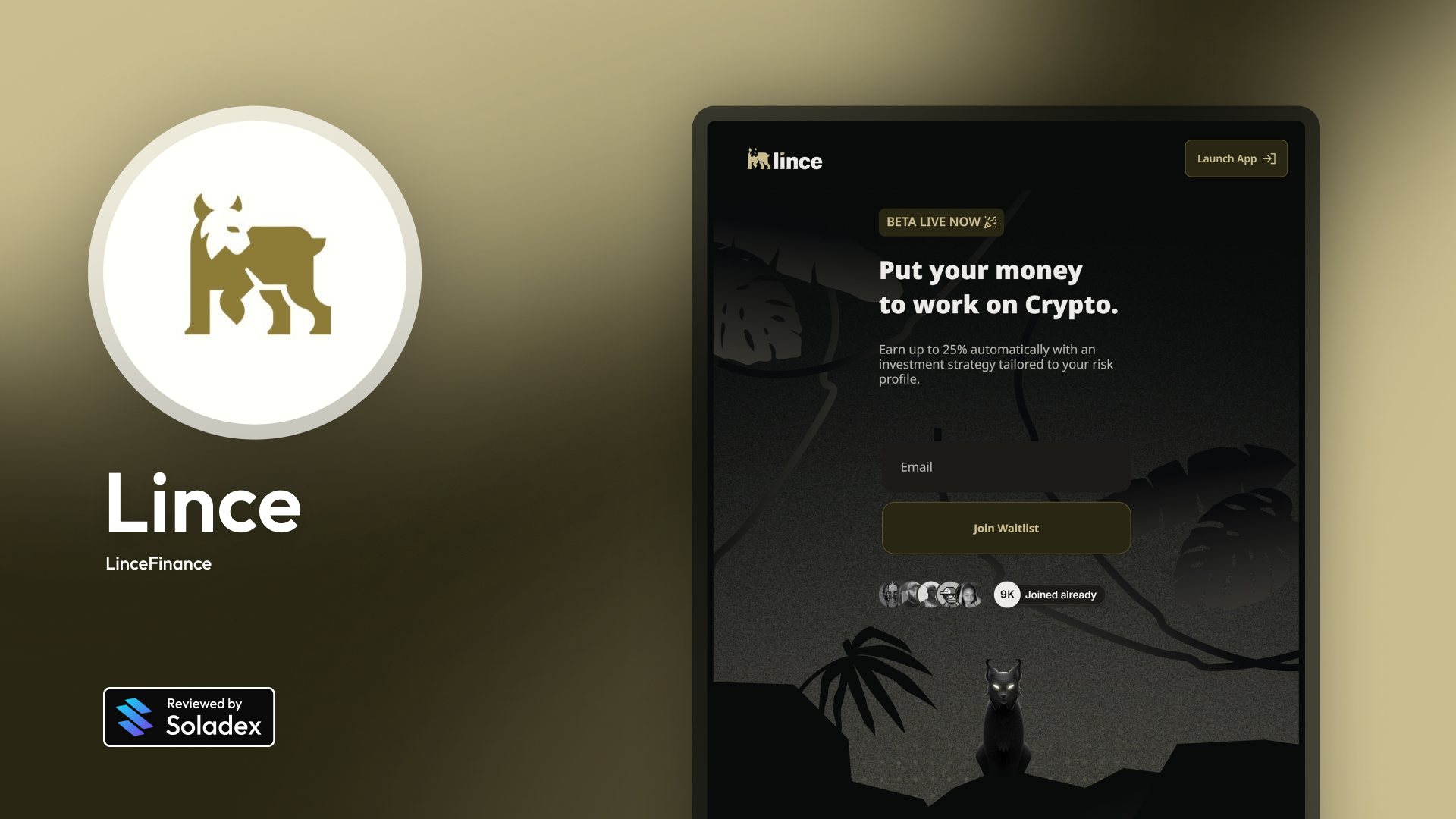
Lince Finance is a DeFi investment platform built on Solana that simplifies yield generation. Instead of choosing individual protocols and strategies, you can select a risk-profile strategy and deposit assets. Lince then allocates your funds across multiple DeFi protocols on Solana.
After you select one of Lince’s built strategies, which range from low to high risk and from minimal market exposure (USDC) to full market exposure, the smart contract automatically allocates your funds across multiple vetted and audited DeFi protocols on Solana based on the strategy you’ve chosen. It utilises proven approaches, such as lending, liquidity provisioning, staking, and delta-neutral strategies, on your behalf.
What are the Key Features of Lince?
Tailored Strategies
Lince offers multiple packaged strategies from a low-risk stablecoin approach to high-exposure strategies that seek to maximize yield.
Automated Diversification
Rather than picking protocols manually, your assets are allocated by the Lince algorithm across several DeFi mechanisms (staking, lending, liquidity, hedging).
Solana Native with Ecosystem Incentives
Built on Solana for speed and low fees, Lince enables users to deploy capital efficiently. Additionally, all deposits through Lince that are allocated to protocols with token incentives, such as ecosystem-wide airdrops, are received by depositors. Lince converts it to USDC and includes it in the yield earned for qualified accounts.
Hands-Off Execution
Once you choose your profile, most of the action happens behind the scenes. This makes Lince suitable for users who prefer less DeFi complexity.
Using Lince Dapp
The process begins with onboarding your profile, as Lince’s algorithm asks questions to understand your risk tolerance and goals. After that, you deposit funds (either crypto or fiat) and select a strategy (e.g., low-risk, high-risk). Then Lince automatically allocates those funds across Solana DeFi protocols based on the strategy’s parameters. In this section, I deposited $10 USDC into Lince to demonstrate how the application works.
Sign up with an email address or connect with a Solana wallet to get started. Lince is currently in beta; therefore, an access code is needed to use the application.
After signing up, a financial assistant with the name “Coil” pops up to get you set up on the best possible strategy for you. Follow the steps and answer the questions asked appropriately. If the options provided are not satisfactory enough, input customized answers so that the strategies that would be offered will fit perfectly with your personal investment taste.
After filling up my needs, Lince provides me with the perfect strategy tailored to my taste. “High Risk with Mixed Exposure” was the plan that best fits into my investment approach.
Depositing into the vaults available on Lince can be done using Crypto or Fiat currency. To deposit using cryptocurrency, ensure that there is USDC in the wallet to be used as the deposit.
Powered by onramper, you can deposit an accepted fiat currency into Lince using cards, Apple Pay, Google Pay and other fiat transfer platforms.
The Lince Dashboard lists all the tokens where the strategy selected has the user’s funds allocated. For the Predator strategy (which I used), my deposit was spread across USDC, SOL, BTC, ETH, ZEC and Bonk.
Lince Strategies is a section curated to explore the available strategies based on the level of risk associated with them and the level of exposure required. The higher the Annual Percentage Yield, the higher the level of risk involved.
Using Lince actively accrues points (balance, referral and quests). This qualifies loyal users for whatever rewards are shared with Lince users during any of the seasonal campaigns.
Periodically, Lince drops quests that all users can participate in. This can be trading quests or something unrelated to trading, but still fun, such as a push-up challenge where you send a video as proof of push-ups. These quests also accrue points.
Lince’ Seeker Application
The Lince team released a mobile application for the Seeker phone. All the features of the Lince web app now exist natively on the Solana-native device. It is also worth noting that the Lince mobile app won an honorary award during the Solana Mobile Hackathon, organised by Radiants and concluded on September 16, 2025. Soladex will update this article with a review of the Lince app on the seeker device.
Conclusion
If you’re looking to participate in Solana DeFi but don’t want to deposit and use every protocol yourself, Lince Finance provides a solution for you. Select your risk level, deposit amount, and let the system handle the rest. While this convenience comes with trust and strategy-selection risk (as with any automated service), it offers a compelling way for users who want exposure to yield without micromanaging every move.