


What Is YieldCompass?
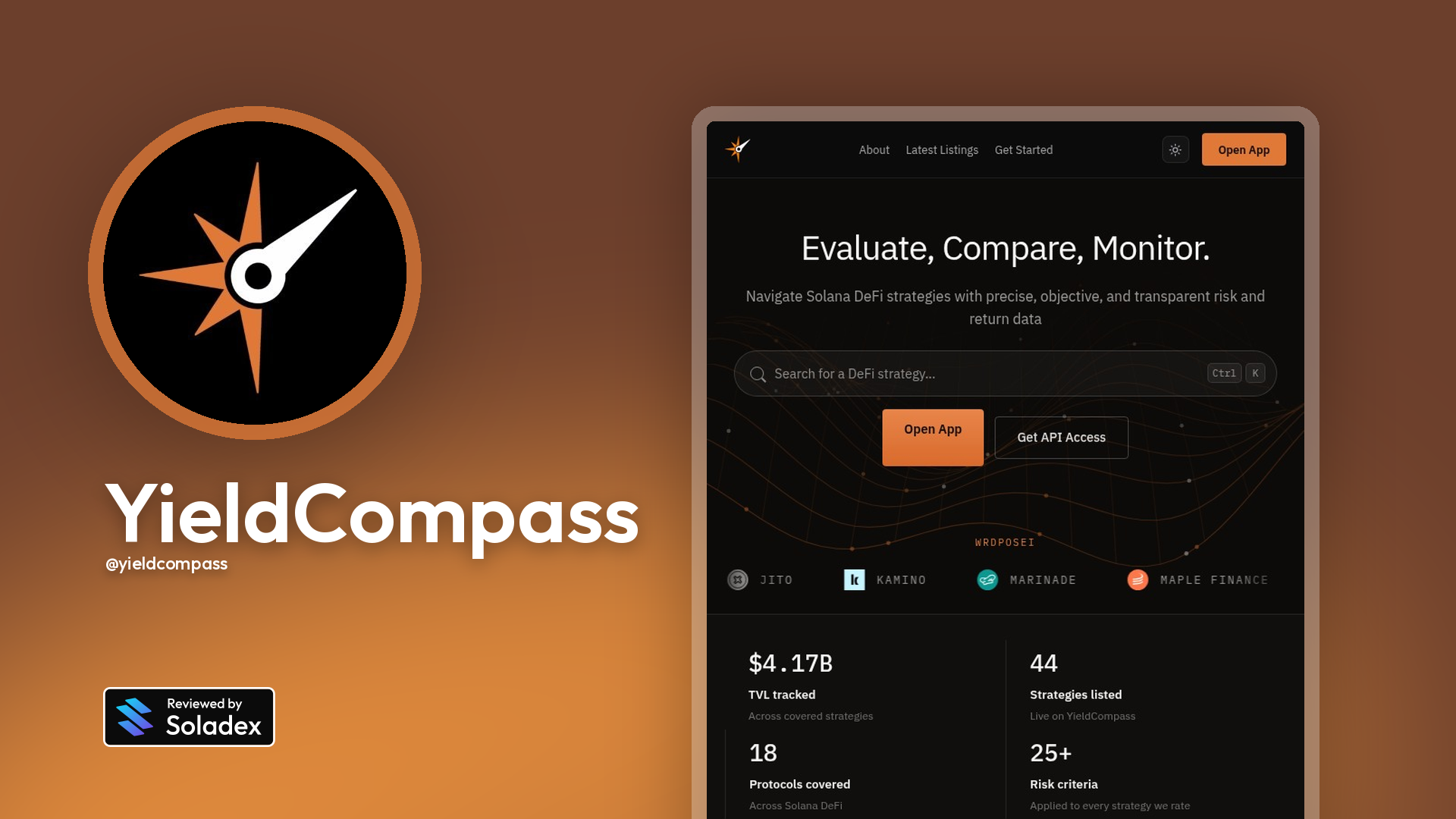
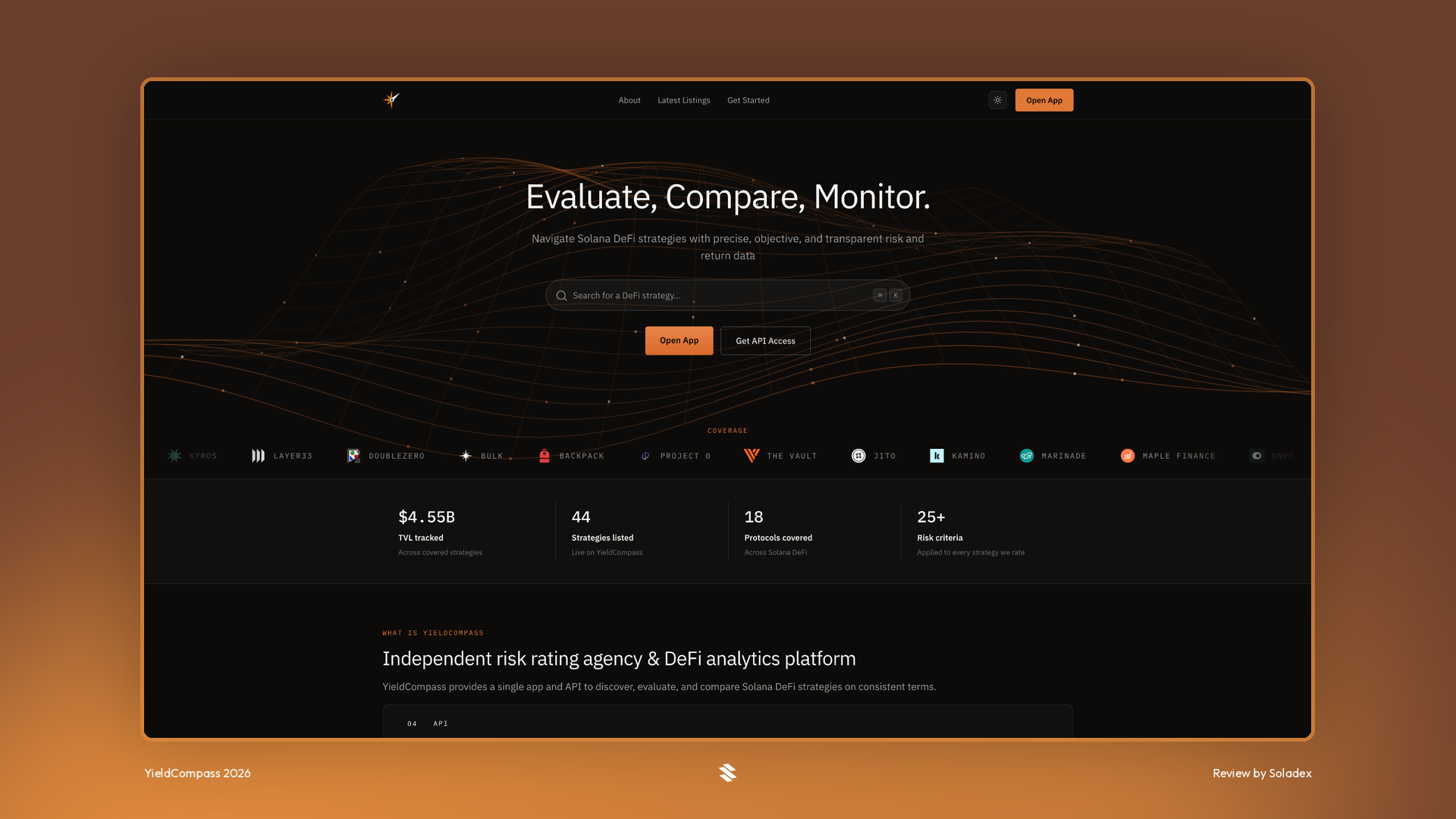
YieldCompass is a Solana DeFi analytics platform built to help users discover, evaluate, and compare yield opportunities. Instead of relying only on the APY displayed by a protocol, YieldCompass makes DeFi yield opportunities easier to understand and compare. It combines independently measured historical returns, risk ratings, and data about liquidity, capital allocation, and protocol security.
What Does YieldCompass Do?
YieldCompass focuses on three main areas:
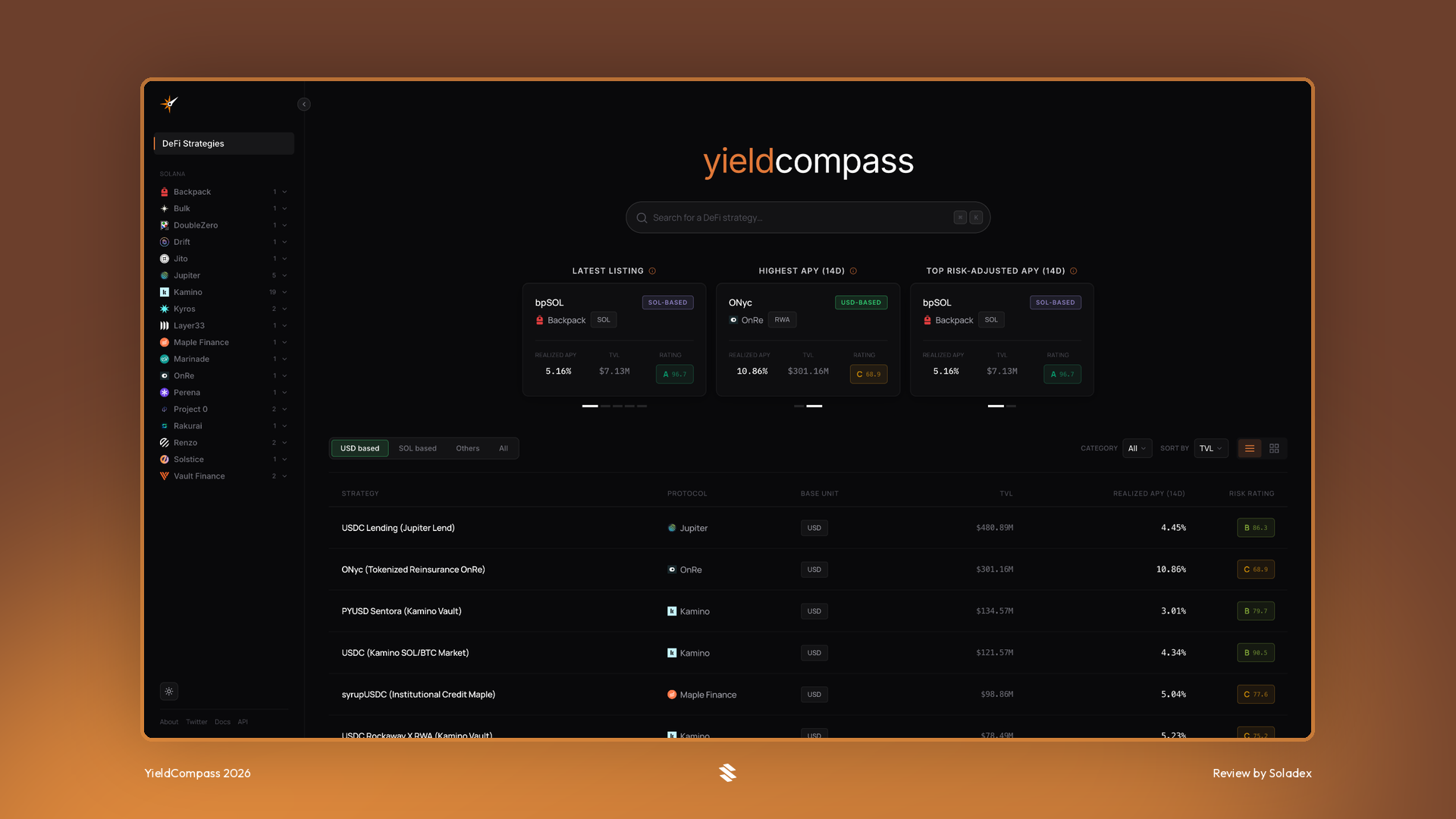
- Risk ratings: Each listed strategy receives an independent A–F risk rating.
- Realized APY: It measures historical yield based on observed on-chain performance rather than only advertised rates.
- Strategy monitoring: It tracks important changes affecting a strategy, such as liquidity conditions, allocations, concentration, and program upgrades.
It currently covers several Solana DeFi strategy types, including liquid staking, restaking, lending, lending vaults, multi-strategy vaults, RWA yield products, liquidity provision, and selected structured products.
How YieldCompass Rates Risk
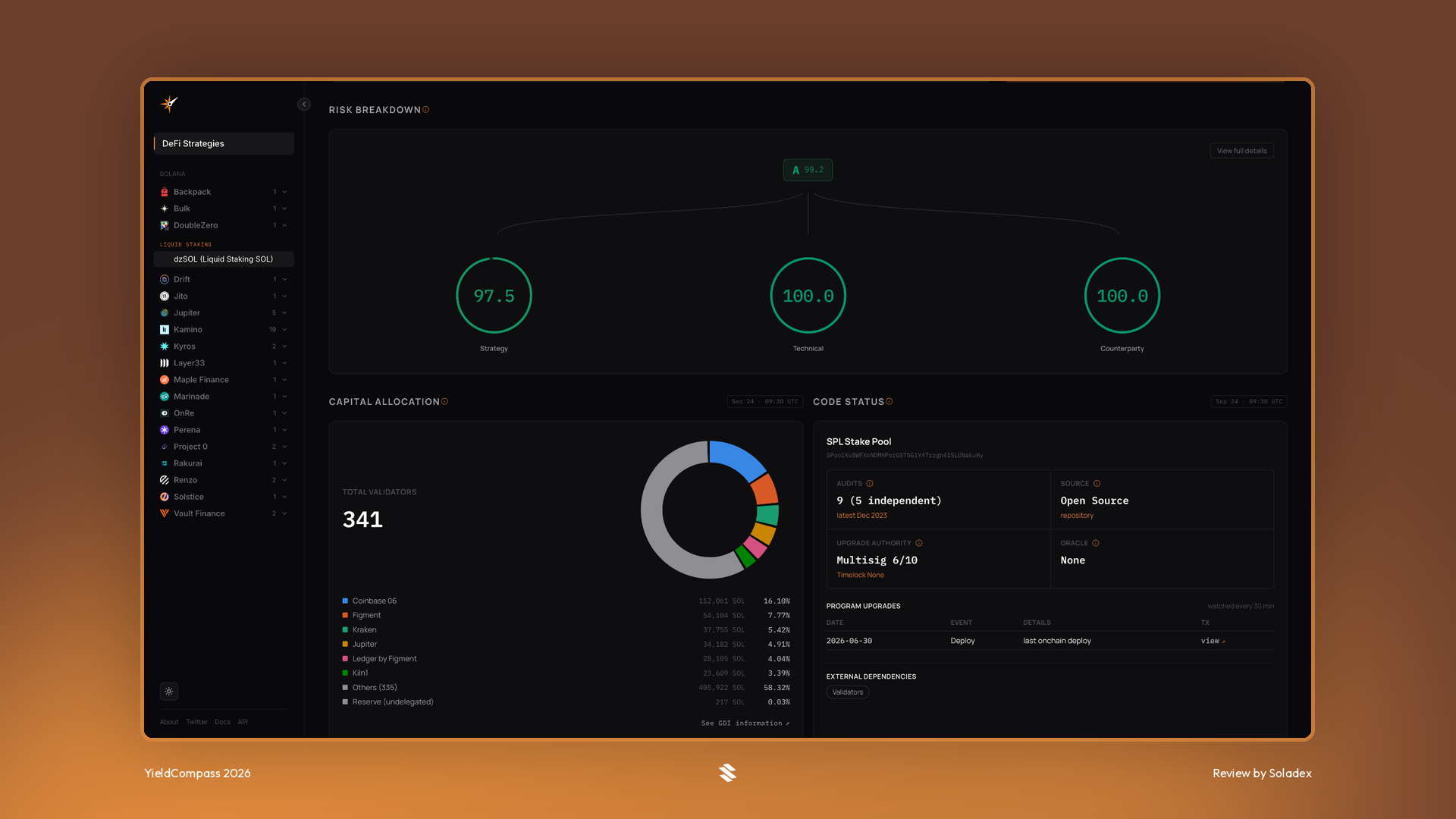
YieldCompass uses a standardized framework to assess the relative risk of DeFi strategies, where each strategy is reviewed across three broad areas:
- Strategy risk: How the strategy earns yield, its complexity, asset exposure, liquidity, and use of leverage.
- Technical risk: Smart-contract security, audits, code transparency, upgrade controls, and operational history.
- Counterparty risk: Reliance on external protocols, oracles, bridges, issuers, custodians, or other third parties.
These factors are combined into a score from 0 to 100, then converted into a simple letter rating. A higher rating does not mean a strategy is risk-free. It is a comparative tool intended to help users understand relative risk across different opportunities.
Monitoring Strategies using YieldCompass
YieldCompass tracks structural data that may affect the safety and usability of a yield strategy. In this section, I will be using the data for DoubleZero.

Realized APY Instead of Advertised APY
YieldCompass measures what a DeFi strategy has actually earned, rather than relying only on the APY promoted by a protocol. This helps make returns easier to compare, as advertised rates may include temporary incentives or exclude costs such as withdrawal fees and lockup periods. For DoubleZero, users can see its realized APY through a clearer historical view of a strategy’s performance across recent periods. However, it is not a guarantee of future returns, as DeFi yields can change with market conditions, liquidity, and protocol incentives.
Capital Allocation
Capital allocation shows where a strategy’s funds are being deployed. For example, it may show lending utilization, validator distribution, or a vault’s allocation across different markets. The current protocols topping the allocation list in DoubleZero deposits are Coinbase 06, Figment and Kraken. This helps users understand what their capital is exposed to instead of focusing only on the headline APY.
Exit Liquidity
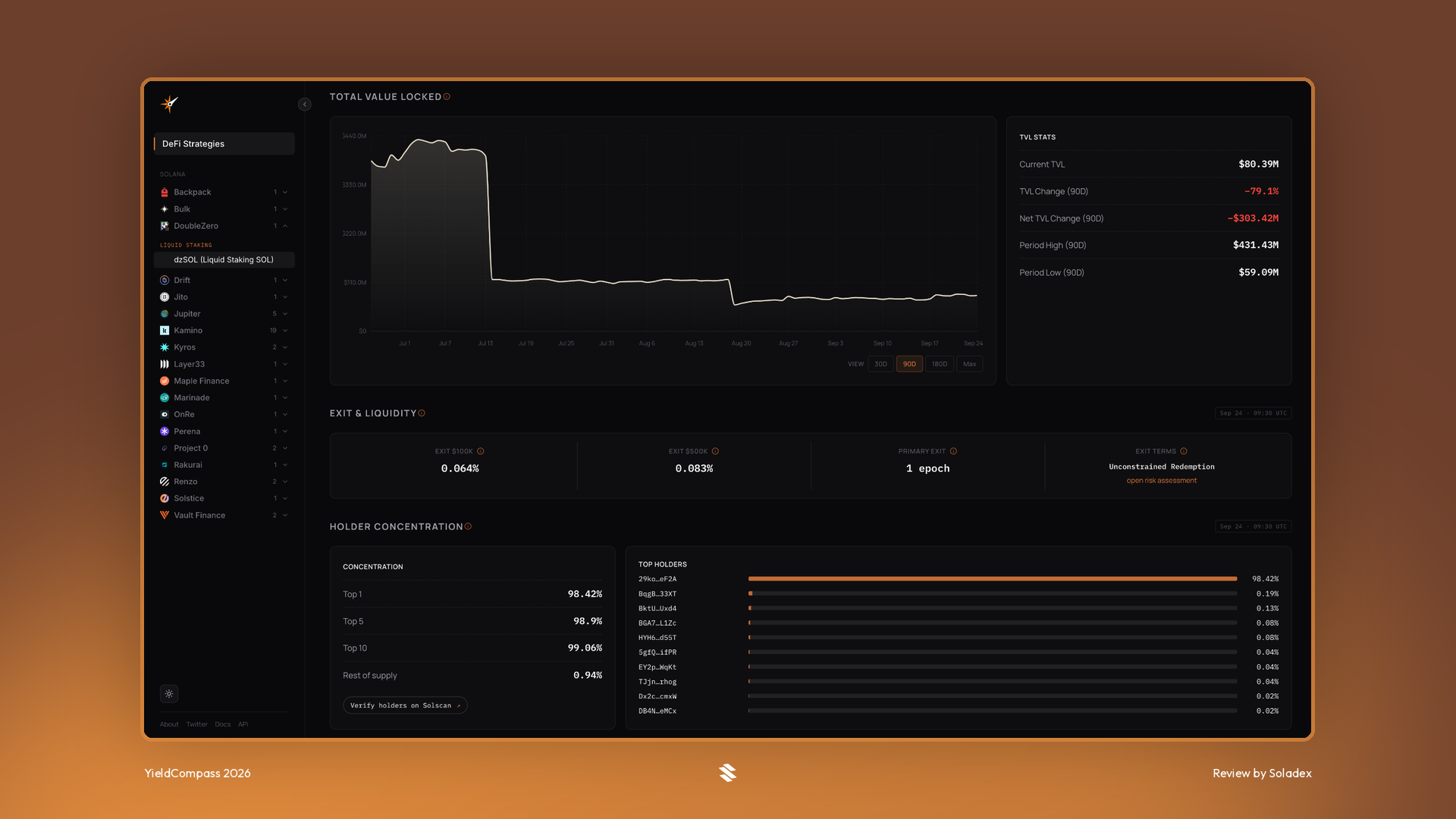
A high yield is less useful if a position cannot be exited easily. YieldCompass monitors withdrawal conditions, available liquidity, expected exit costs, and cooldown periods. For lending strategies, this can include available liquidity and utilization. For tokens that must be sold on a market, it can include estimated price impact at different trade sizes. Since the token is denominated in SOL, entries and exits take 1 epoch.
Holder Concentration
YieldCompass tracks how concentrated the ownership of a strategy token is among large holders. Concentrated ownership can create additional risk, especially if large holders exit during periods of low liquidity or market stress. The platform displays the share held by the largest wallets and flags known program-owned accounts where possible. DoubleZero has 98.42% of the total asset in one wallet from a single holder.
Risks to Consider
YieldCompass provides analytics, ratings, and historical data, but it does not remove the risks of using DeFi. Risk ratings are based on a methodology and available information, but no score can predict every possible failure, exploit, liquidity problem, or market event. Data may also change as protocols update their contracts, liquidity shifts, or new information becomes available.
Conclusion
By looking beyond promotional APY figures, YieldCompass gives users a clearer view of how strategies work, what risks they involve, and how easily positions may be exited. It does not make DeFi risk-free, but it can be a useful research tool if you are seeking a more informed approach to Solana yield opportunities.