


What is PMX?
PMX is a Solana-based platform that combines token launches with onchain prediction markets. Instead of pairing every launched coin with SOL or USDC, PMX allows creators to pair it with an outcome token representing one side of a prediction market. This gives each coin two sources of price movement: trading activity in the coin itself and changes in the probability of its selected outcome. A coin backed by a losing outcome becomes worthless when the market resolves. The PMX app is still in active development.
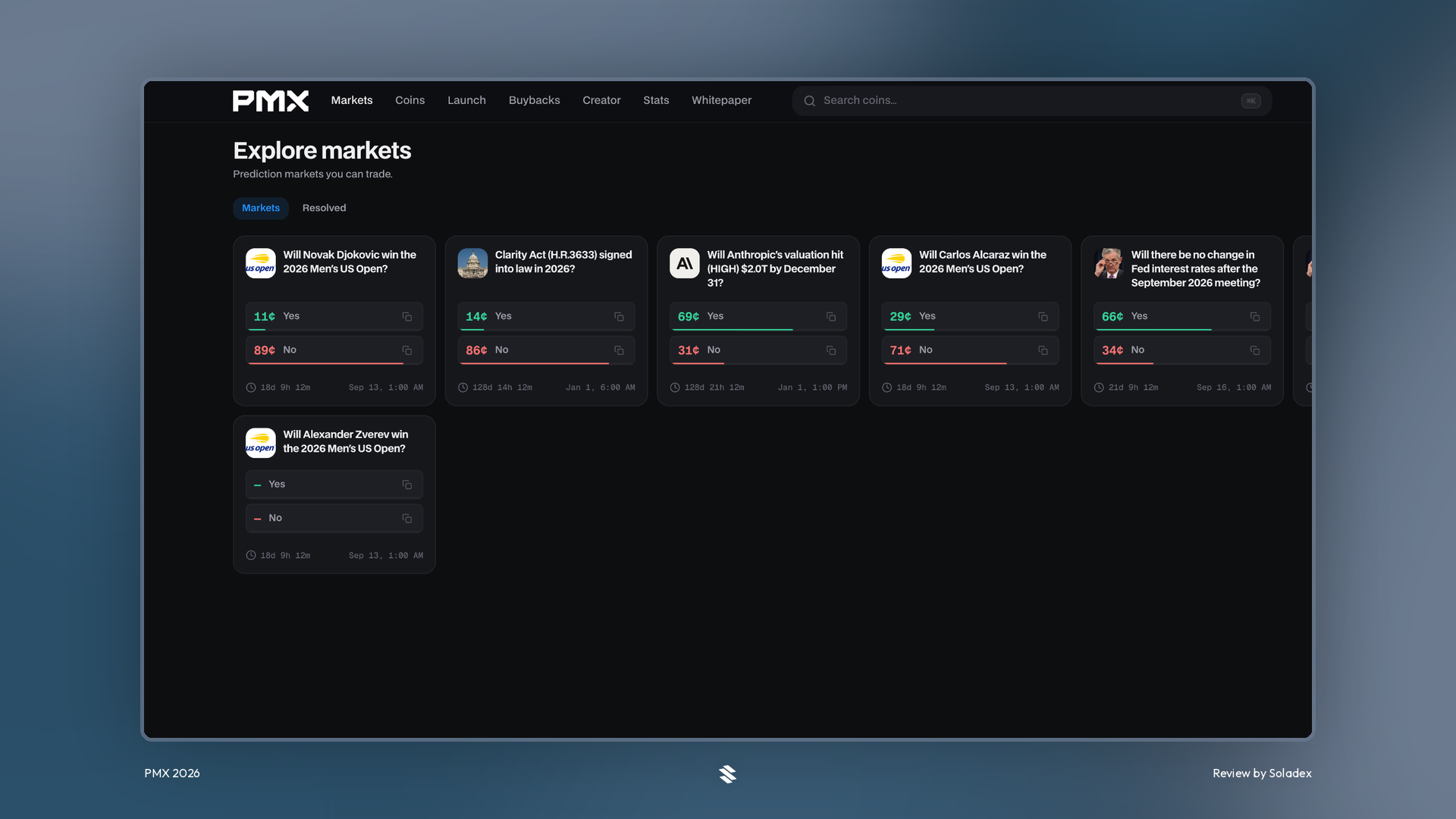
PMX Prediction Markets
PMX is built on an onchain binary prediction market. Each market has two outcomes, such as YES and NO, represented by separate SPL tokens. If YES trades at $0.40, the market is broadly expressing a 40% probability. NO should trade near $0.60, with both sides adding up to approximately $1. Each outcome token trades against USDC through an onchain liquidity pool. In this type of market, users do not need an order book or a matched counterparty. You only need to swap directly against the pool. This is the backbone of PMX's token launch system.
How PMX Launches Work
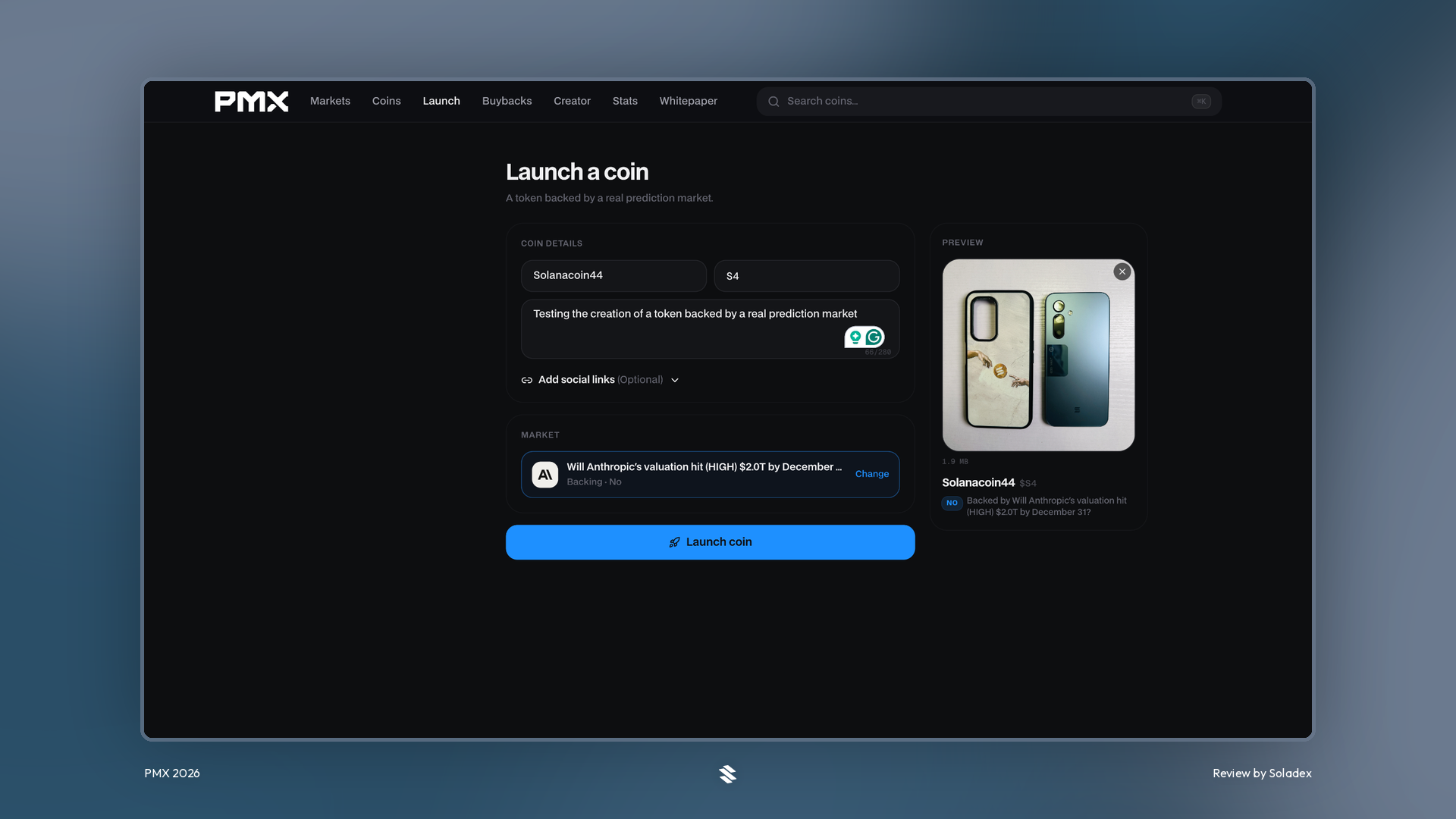
When launching a coin, the creator selects a prediction market outcome as its backing token (In the screenshot below, the market speculating on Anthropic’s valuation was selected as the market). This decision cannot be changed after launch. For example, a coin called JPOW might be paired with FEDYES, and the YES token for a market asking whether the Federal Reserve will leave interest rates unchanged after a specified meeting. If the market gives that outcome a 40% probability, FEDYES should trade near $0.40. The coin then trades through a permanent JPOW/FEDYES pool rather than a conventional JPOW/SOL or JPOW/USDC pair. There is no bonding target, migration, or graduation stage.
Every PMX coin launches with the same basic parameters:
- A supply of one billion tokens;
- All tokens placed in the pool at launch;
- A starting market capitalization of $5,000, converted into the backing token;
- A flat 3% fee on trades; and
- No fixed cap on subsequent price movement.
A Coin’s Lifecycle
A PMX coin passes through three principal stages.
Launch
The creator selects a market, provides a name and image, and launches the token directly into its permanent outcome-token pool.
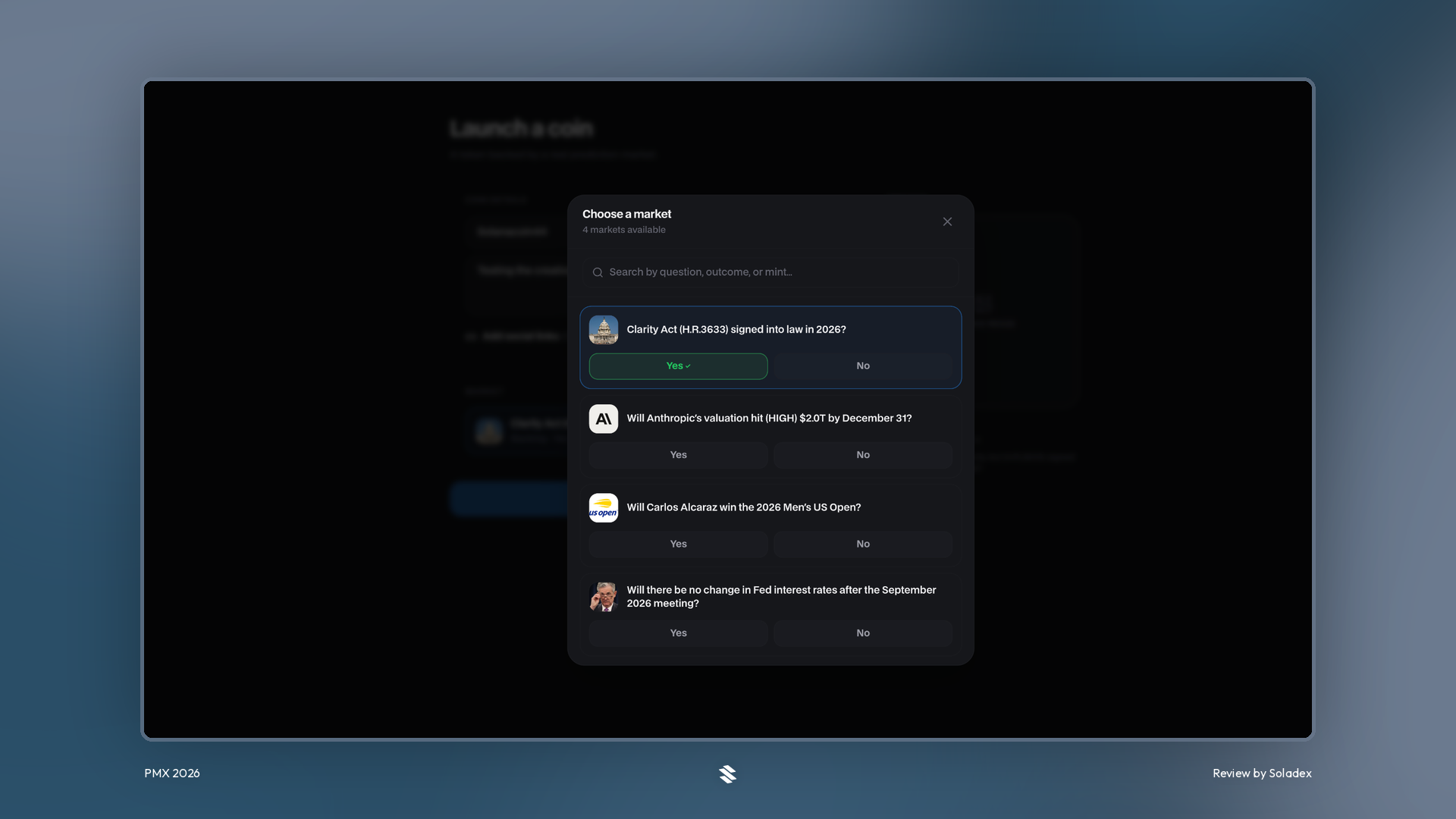
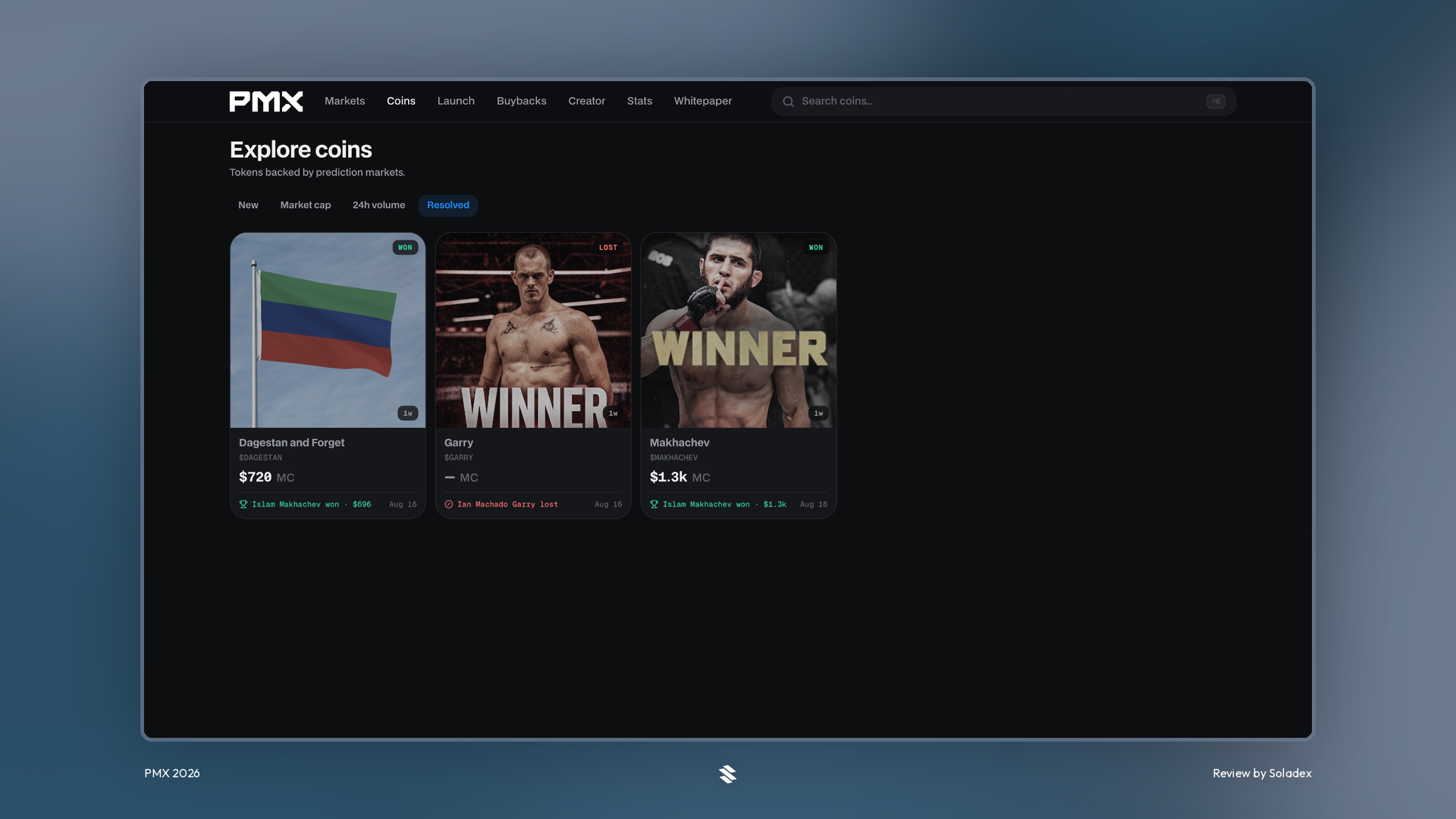
Choose a market to back your coin (I chose the Anthropic market). While active, its value reflects both trading activity and changing market odds. At resolution, trading pauses and winning outcomes transition to a permanently locked coin/SOL pool, while losing outcomes leave the coin worthless and its pool closed.
The coins below are backed by prediction markets that have already resolved.
Fees and PMX Buybacks
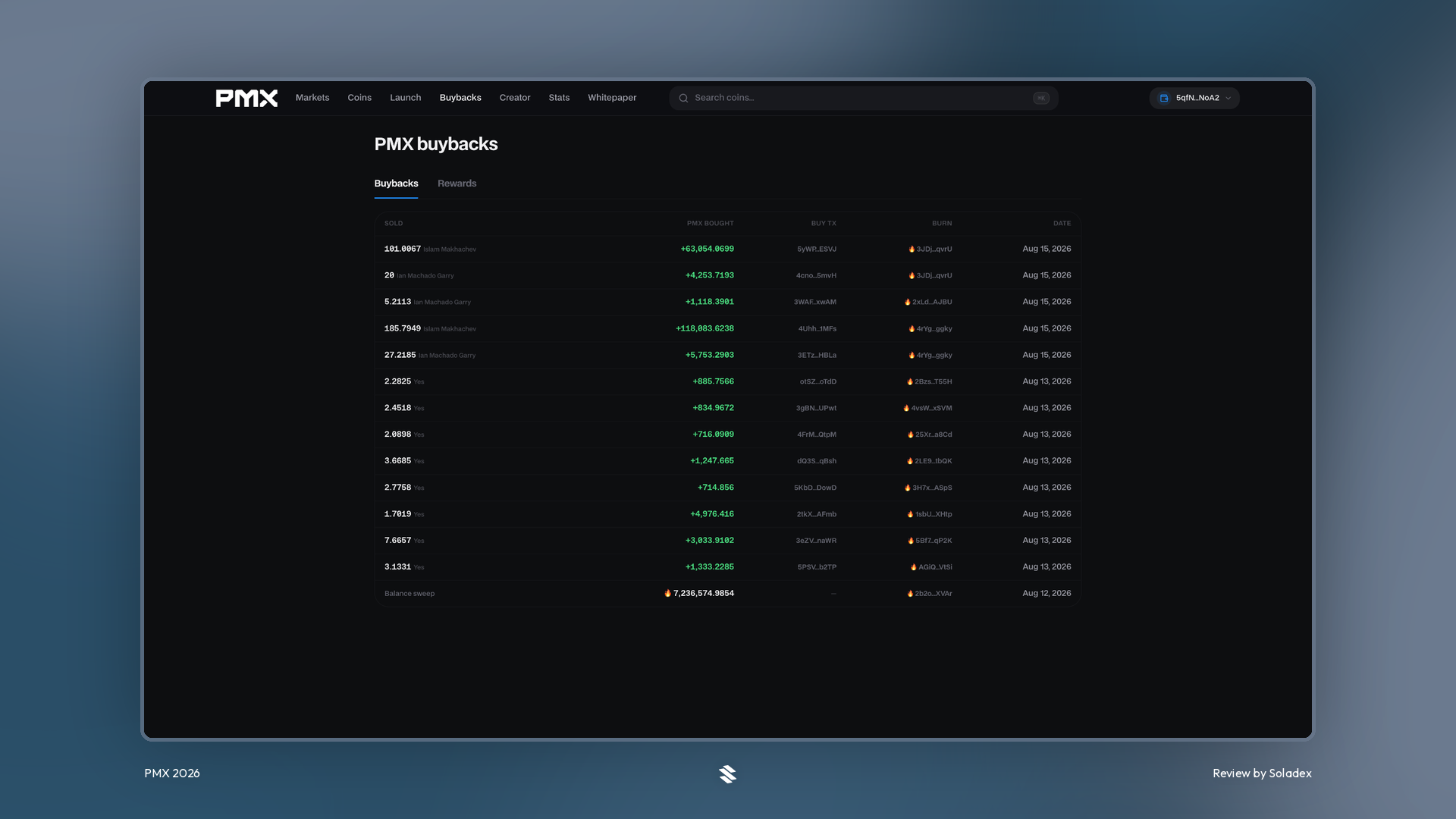
Every coin trade carries a 3% fee, distributed among coin holders, the coin’s creator, and PMX token buybacks and burns. Holder distributions are sent directly to eligible wallets rather than requiring a separate staking or claims process. The PMX portion is used to purchase PMX tokens on the open market and burn them, reducing supply.
Key Risks and Considerations
PMX carries binary-outcome, market, liquidity, smart-contract, and market-making risks. A coin backed by a losing outcome can fall to zero, while thin liquidity in the backing token can make trading difficult and expensive. Any price above the value implied by the backing remains speculative, and liquidity providers may face impermanent loss. Since PMX is still under development, it is not very liquid, and it's not as functional as it should be. Users should be willing to try it out with a small amount.
Conclusion
PMX prices launched coins in prediction-market outcome tokens, making their value responsive to trading and changing odds. Winning coins transition to locked SOL pools, while losing coins become worthless.