


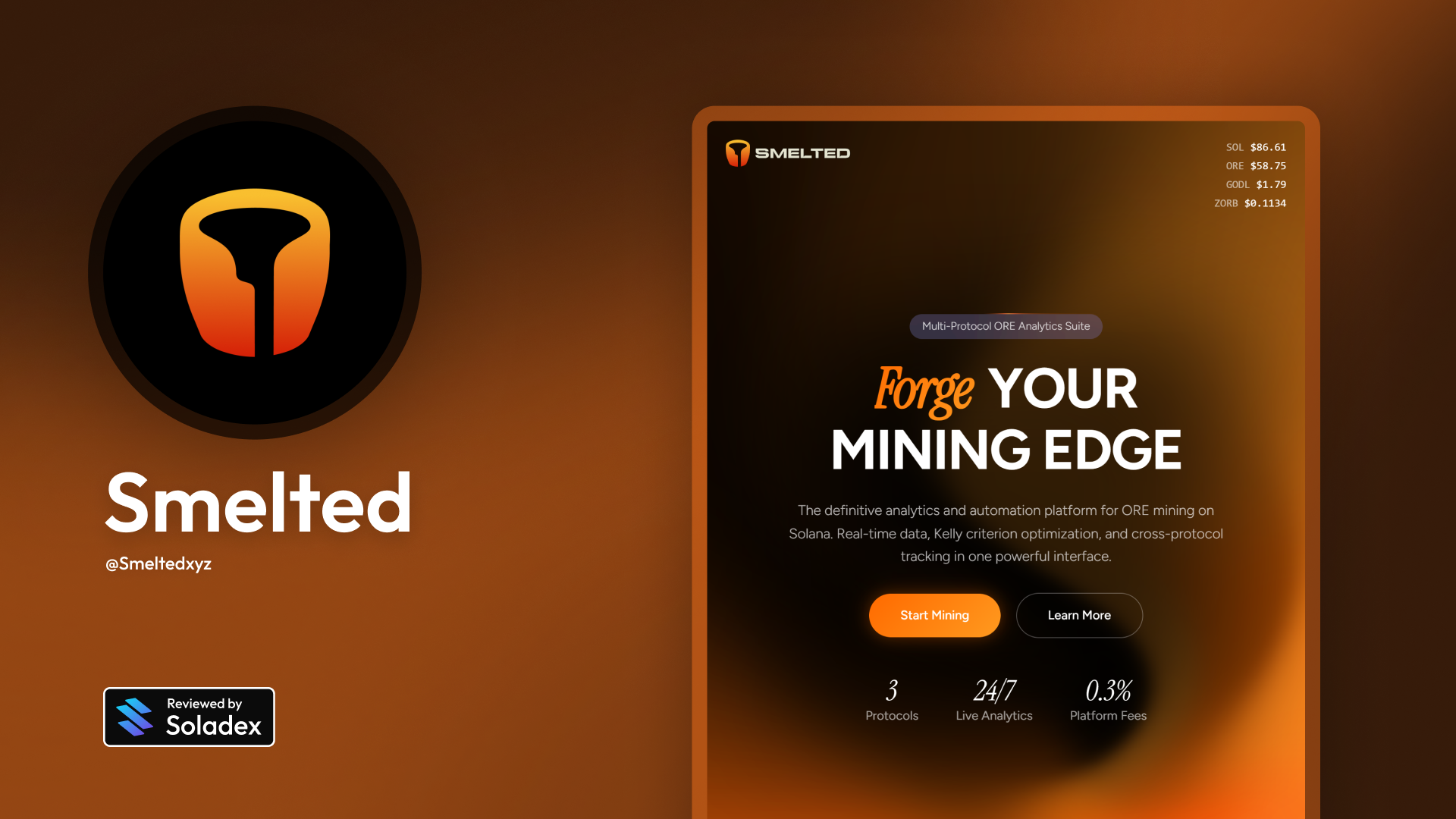
What Is Smelted?
Smelted is a full-stack platform built to handle mining processes on Solana, such as wallet management, transaction signing, live round monitoring, historical analytics, and the execution of automated strategies. Smelted is designed to be a single interface for all things mining on Solana. Proof-of-work mining on Solana is not like Bitcoin mining. There's no specialised hardware, energy-consuming rigs, or arms race over raw compute power. Instead, some mining protocols on Solana, such as ORE, GODL and ZORB, run entirely on-chain, using SOL deployments and randomness to determine winners each round.

What Is Proof-of-work Mining on Solana?
ORE and GODL are proof-of-work protocols that are native to Solana. But rather than hashing computations like Bitcoin, the work done here is deploying SOL to tiles on a grid each round and then the protocol selects a winning tile on-chain. All the miners who deployed to that tile earn rewards proportional to their contributions.
How does this mining work?
Every round across ORE and GODL follows the same core cycle. The following steps highlight how the mining process works:
Step 1: A new round opens
The protocol opens a fresh 5x5 grid of 25 tiles. Every round is a clean slate, and none of the prior deployments is carried over.
Step 2: Miners deploy SOL to tiles
You choose one or more tiles and deploy SOL to them. This is your mining action for the round. Deploying more SOL on a tile results in higher competition for that tile's reward share. If many miners pile onto the same tile, the rewards get split more ways. You can spread across multiple tiles if your strategy calls for it.
Step 3: The round closes, and a winner is selected on-chain
After the round timer expires, the protocol determines the winning tile using a verifiably fair on-chain method. The protocol XORs values from the Solana slot hash and takes the result modulo 25 to select the winning tile. The outcome is on-chain and deterministic. Since it uses the slot hash, it can't be manipulated by the protocol or any single participant. The method is not based on pure randomness in a black-box sense, but it is cryptographically derived from Solana's own infrastructure.
Step 4: Rewards are distributed
Miners who deployed SOL to the winning tile receive rewards proportional to their share of that tile's total deployment. And many times, winning miners get back more than their deployed SOL, depending on the number of tiles selected. Rewards are paid in two forms:
- SOL deployed and some extra (depending on the strategy used)
- The protocol's native token (depending on which protocol you're mining)
If you did not select the winning tile, you don't receive rewards for that round, and your deployed SOL is redistributed to those who selected it, minus the eprotocol fee.
After the steps are completed, the cycle repeats.
What Smelted does
Mining these protocols manually across multiple rounds, multiple protocols, and multiple wallets is intensive and demanding. Smelted handles the full stack, and you no longer have to do it by hand.
Smelted also offers automated strategies such as Kelly Optimal, Low Pool (lowest SOL deployed tiles), Best EV (expected value), Random tile selection (from 1 - 20+), and Evens/Odds (the algorithm selects all Even or Odd tiles).
Lastly, Smelted has a sizing feature (outside Kelly Optimal) that automates the amount deposited in the tiles. Users can select a fixed size or the Martingale option that doubles their bet size for each loss until they win, then it resets.
Wallet management and transaction signing
Smelted connects to the Solana blockchain and handles the operational layer by managing wallets, constructing your transactions, and signing deployments. This removes the need to interact with each protocol's on-chain interface manually every round.
Real-time round monitoring
As seen on the page below, Smelted has a timer, a live grid showing current deployments, and the competitions happening on the grids. Smelted surfaces all of this in real time so you can see which tiles are attracting the most SOL, where you're currently deployed and how the round is progressing before it closes. Positive expected value (EV) is displayed at the bottom of each tile for both ORE & GODL grids. These are the numbers highlighted in green below.
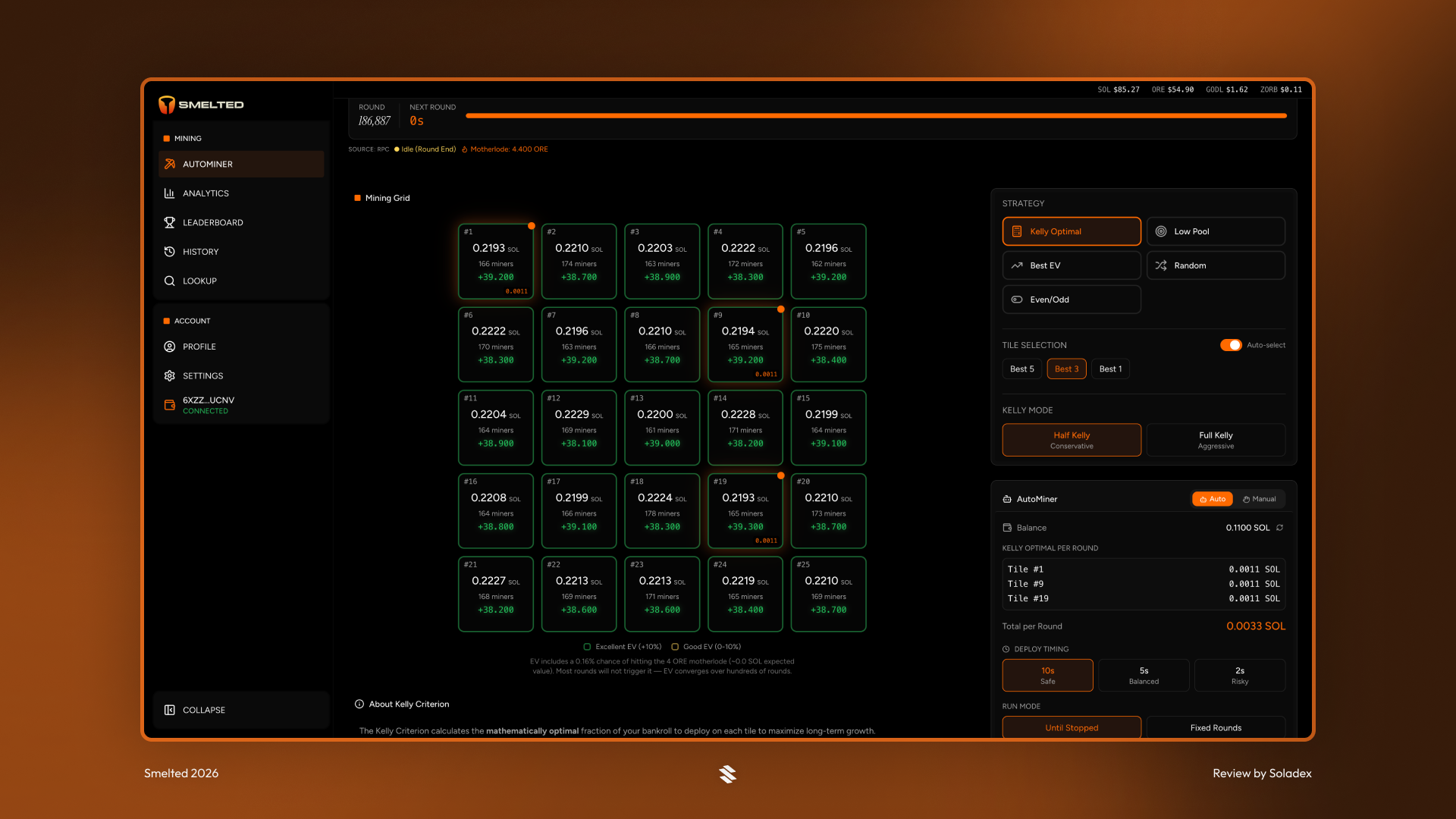
For manual miners, this is the information layer that informs your tile selection. For automated miners, it's the data feed that the Smelted AutoMiner acts on. To switch to manual mining, click on the “Manual” button in the AutoMiner panel, as shown below.
Cross-protocol tracking and Historical analytics
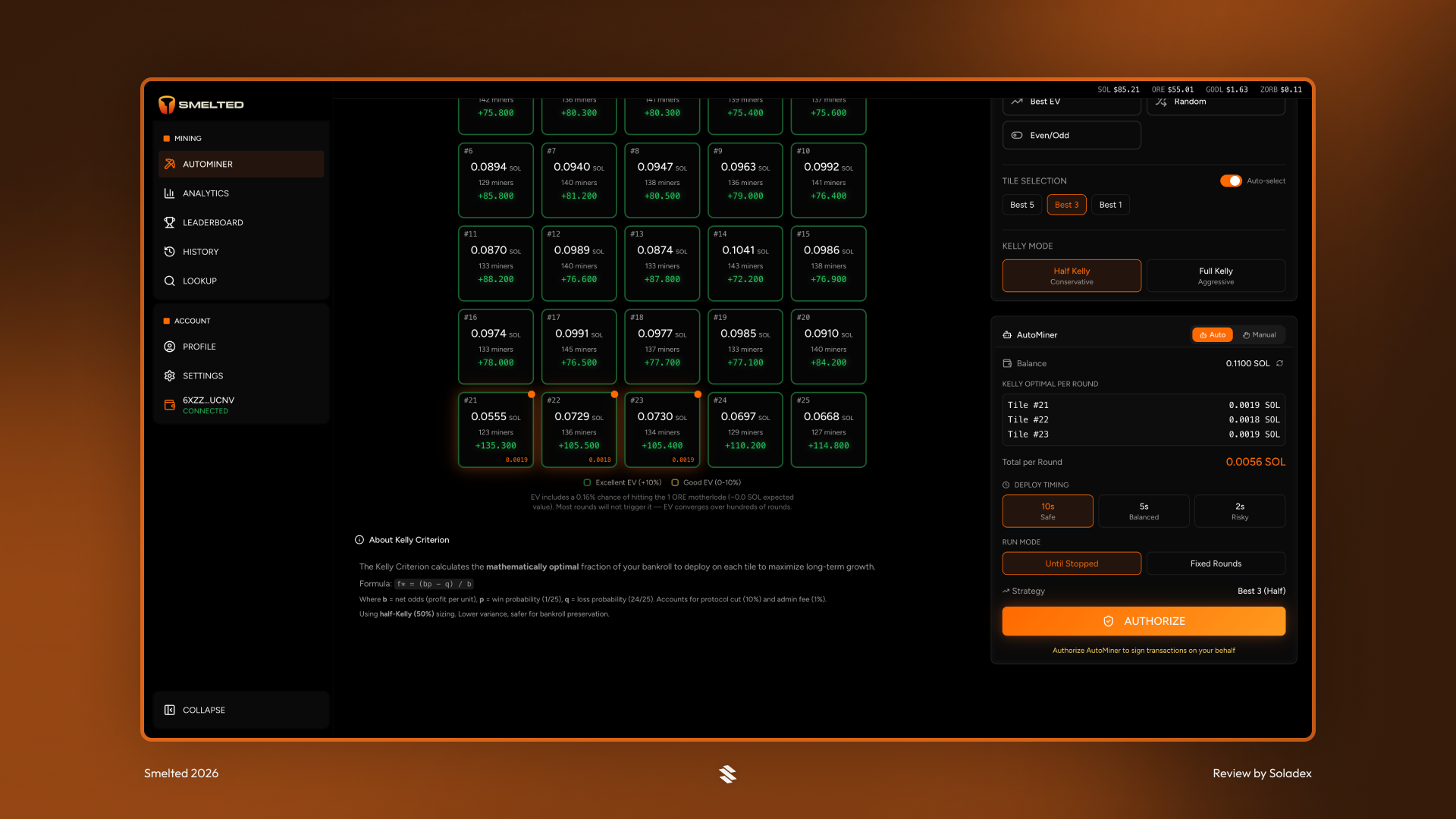
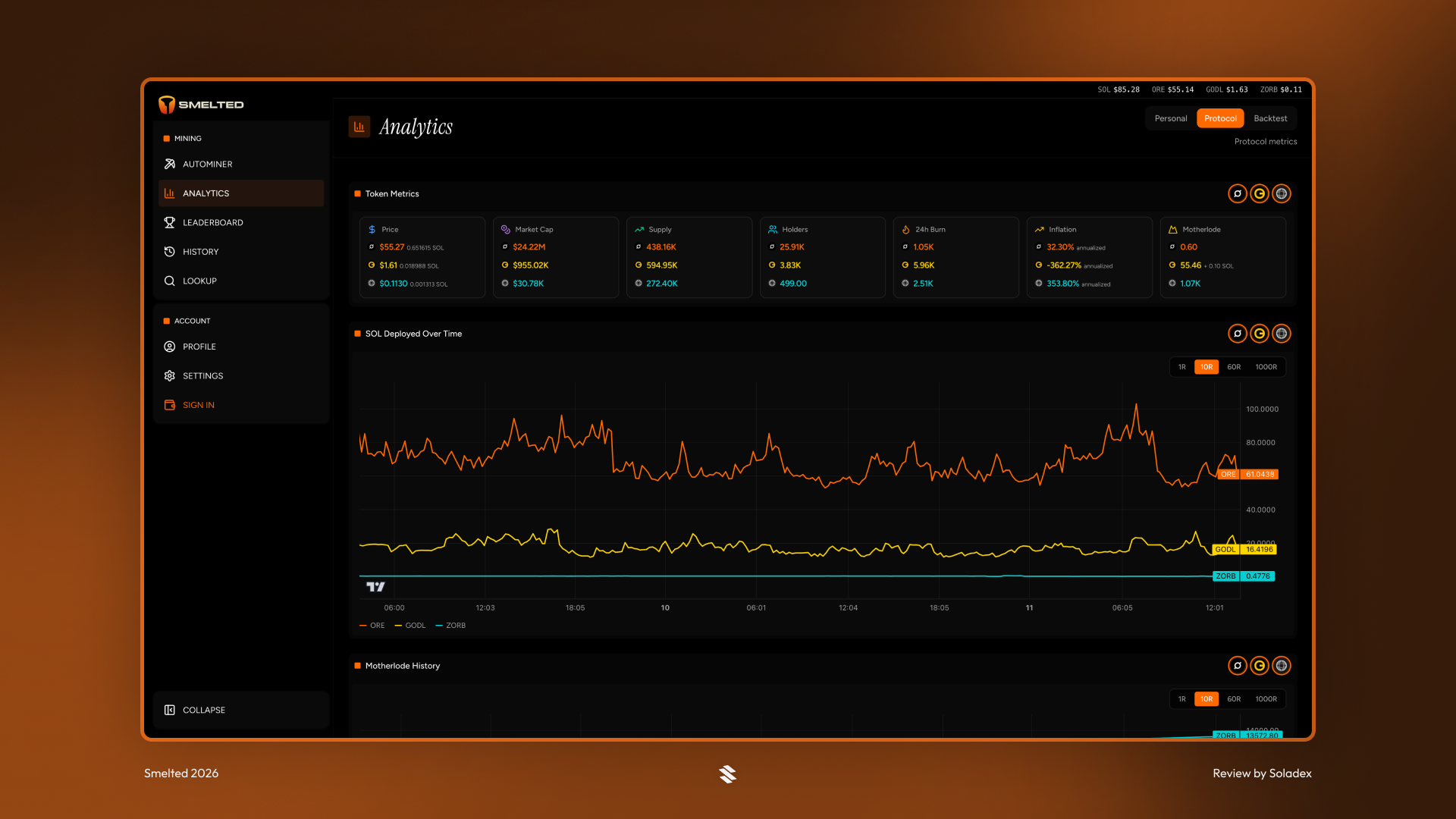
Because Smelted supports ORE, GODL and ZORB simultaneously, you get a unified view of your entire mining operation in one interface instead of switching between protocol UIs and block explorers. Smelted's historical analytics layer gives you a view across these protocols so you can evaluate what's actually working for you. What matters is your performance across many rounds: win rate, average reward per round, SOL efficiency, and how your strategy compares to naive approaches, and Smelted provides this in its analytics section. Other mining protocols will be supported on Smelted once they demonstrate they are here to stay and are being used in the Solana ecosystem.
Miner Lookup
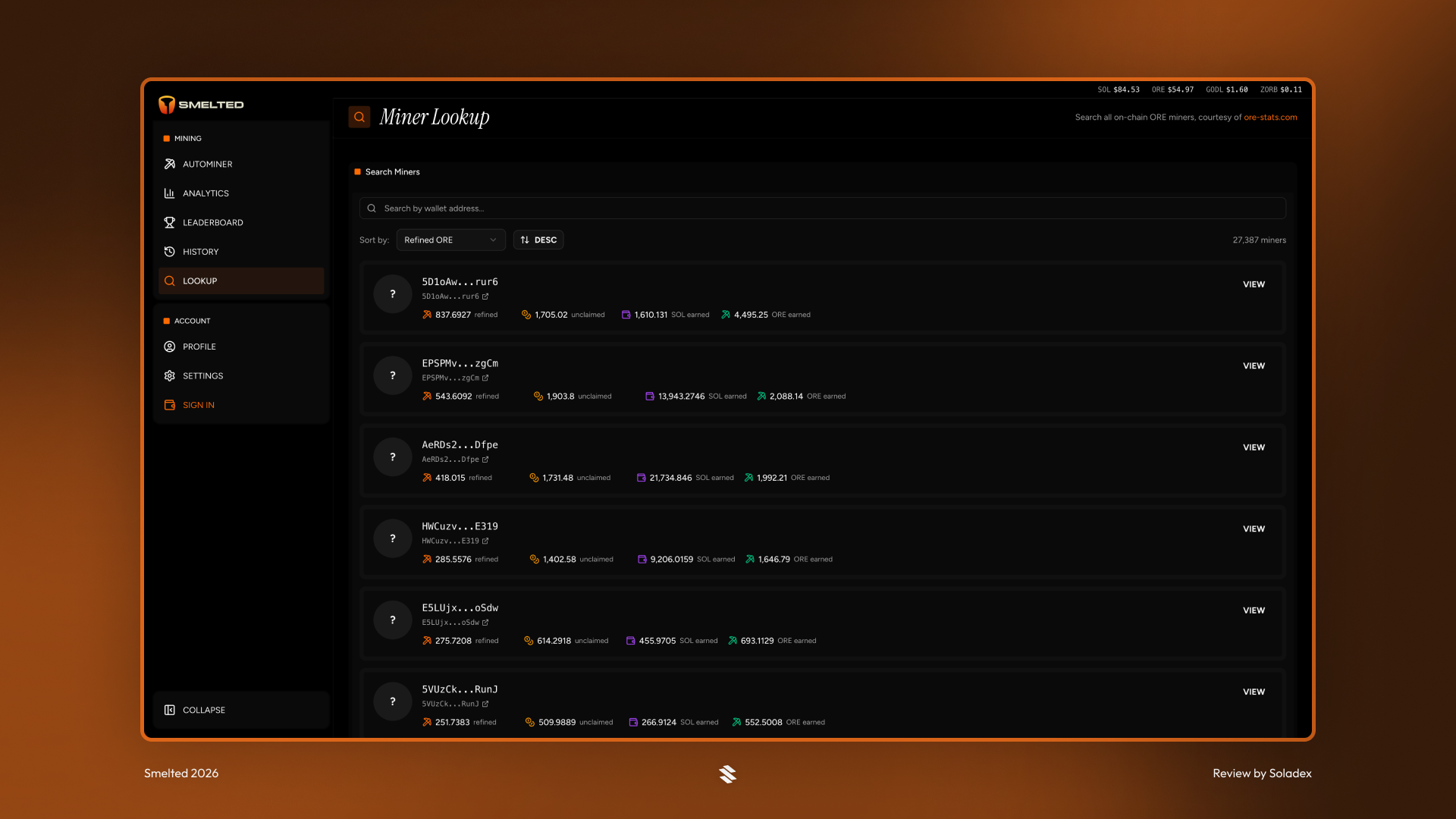
Smelted provides a unique explorer that curates all mining activities in a wallet. To get detailed information on the account, click View. This feature is currently available for users’ mining activities on ORE.
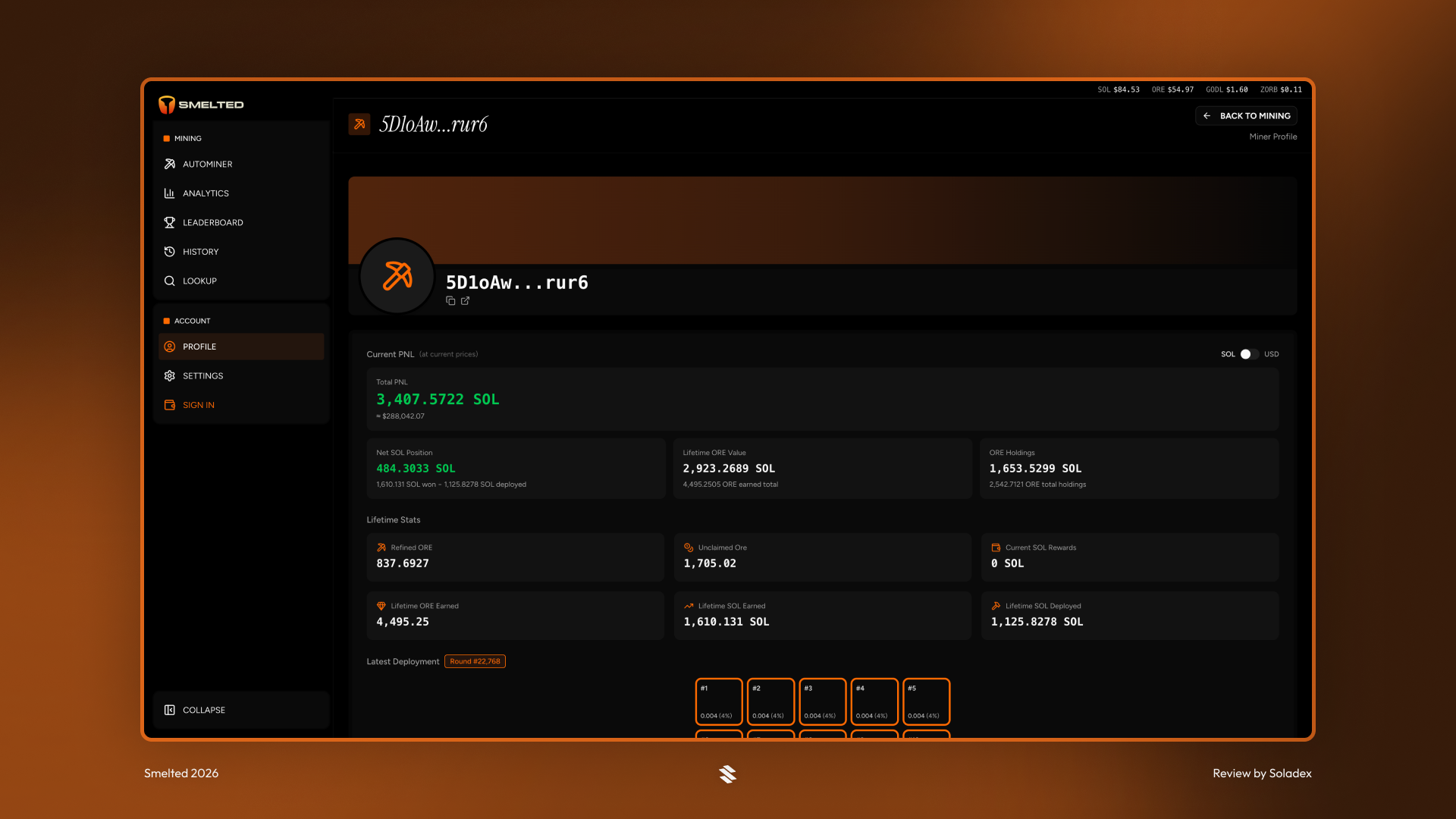
After clicking “view”, a new page with the account is displayed. The dashboard provides the important mining details on the miner’s account, such as their Profit and Loss (PnL), the amount of tokens mined from the protocol (e.g., ORE) and their lifetime earnings from the protocol.
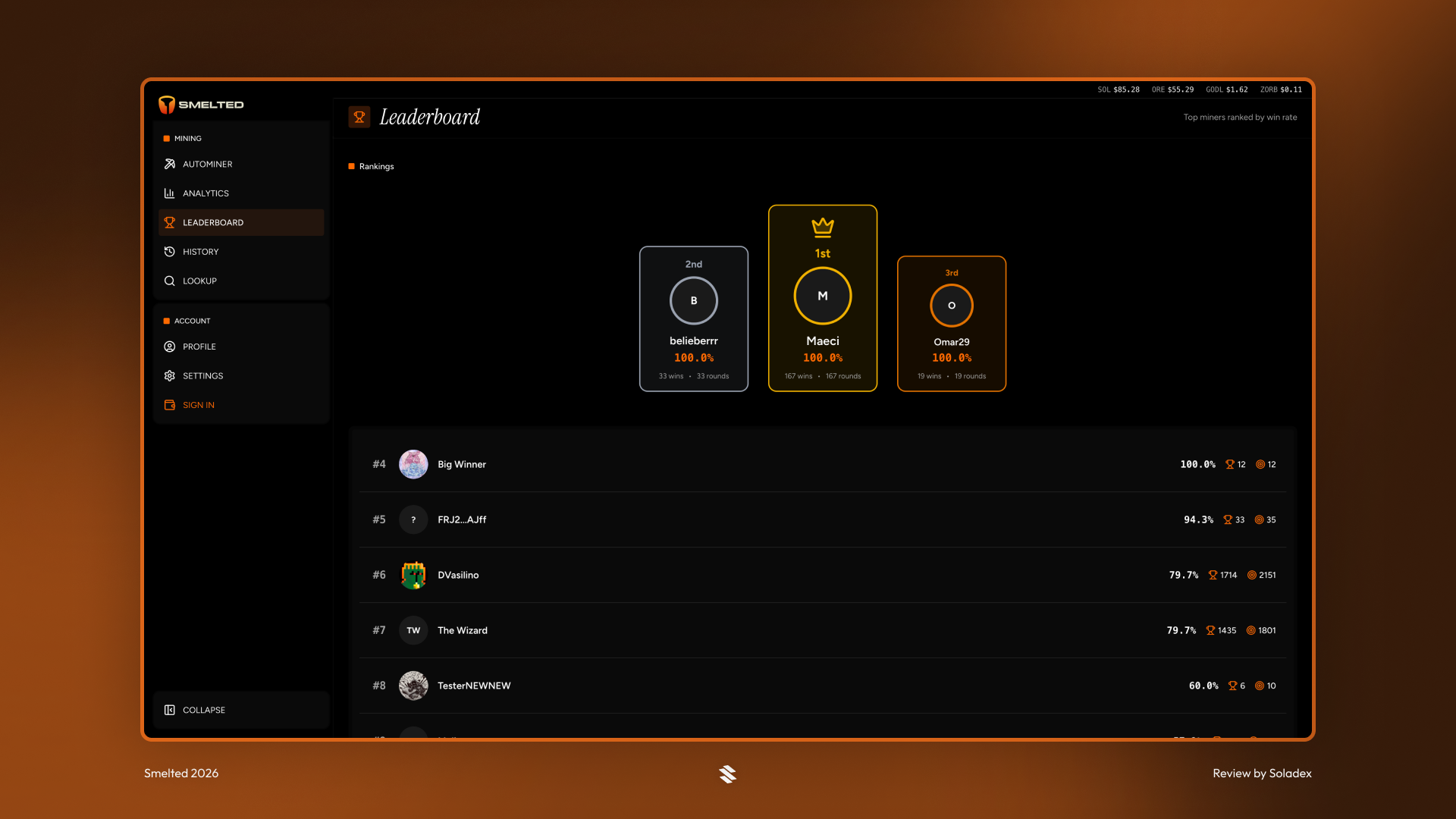
Smelted has a leaderboard ranking for winners and their winning rates.
Getting started with Smelted
- Connect your Solana wallet (Phantom or Solflare recommended) and access the wallet created for the account on Smelted. Fund it with SOL as it will be needed for both deployments and transaction fees.
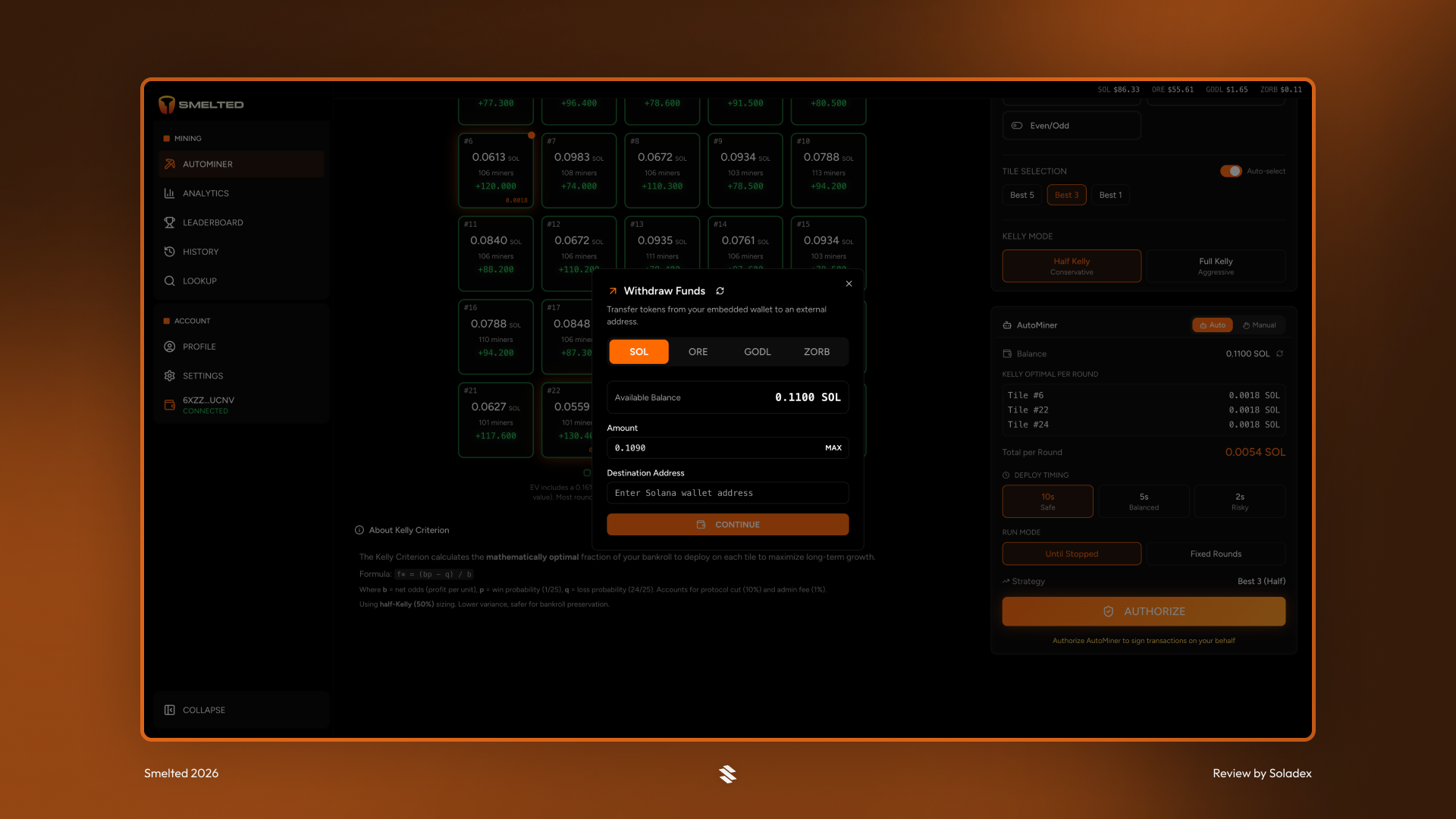
- Start with one protocol (ORE is the most established starting point) and mine manually for a few rounds to build intuition about the grid, timing, and the competition involved.
- Smelted has a backtesting feature that miners can use to check out the best strategies to use based on the last 1230+ rounds before deploying any strategies. This feature helps in simulating helpful strategies, and it is only available on Smelted.
Conclusion
Smelted is built to combine real-time rounds, historical analytics, and cross-protocol tracking across mining protocols on Solana. It mathematically optimized automation into one platform. It gives miners the infrastructure to mine smarter rather than harder. If you're going to mine tokens across ORE, GODL, or ZORB on Solana, Smelted relieves you of the need to actively manage multiple protocols.